


Customer Stories


Customer Background
This manufacturing group is a Fortune 500 enterprise with chemicals as its leading industry, integrating over ten sectors including thermal power, logistics, forestry, and environmental protection. The company has successively obtained ISO 9001:2000 International Quality System Certification and ISO 14001 International Environmental Management System Certification. It has been honored with numerous provincial-level and national awards, including the "National May Day Labor Award," "National Contract-honoring and Credit-worthy Enterprise," and "National Key High-Tech Enterprise."
The group places great emphasis on the construction of its information systems, having established a complete set of business systems including ERP, OA, and BPM. Core business operations run on HP minicomputers, while non-core operations utilize various versions of Windows and Linux operating systems, as well as multiple versions of Oracle and SQL Server databases. Some services run on virtualization platforms, and others operate on X86 architecture physical machines.
With the development of the group's business, the complexity and data volume of its IT systems have grown rapidly, leading to increasingly higher security requirements. How to quickly and effectively protect IT systems, and how to rapidly recover data and restore crashed systems in the event of a disaster to ensure the efficient and stable operation of business systems, presents a critical challenge that must be addressed.
IT Environment
-
Applications: ERP system, OA system, BPM system, etc.
-
Database: Oracle, SQL Server, etc.
-
Environment: HP minicomputers, X86 servers, virtualization platforms, Dell EMC storage, etc.
IT Challenges
-
Outdated equipment and poor data center environment.
-
Limited existing backup methods, insufficient disaster and fault defense capabilities, and low recovery efficiency.
-
Lack of off-site disaster recovery, unable to defend against site-level failures.
FcStor FDP Integrated Disaster Recovery Solution
-
Service-based delivery.
-
Comprehensive protection for various business data.
-
Integrated defense combining local backup and cloud disaster recovery.
-
Perfect compatibility with various systems, defending against all types of failures.
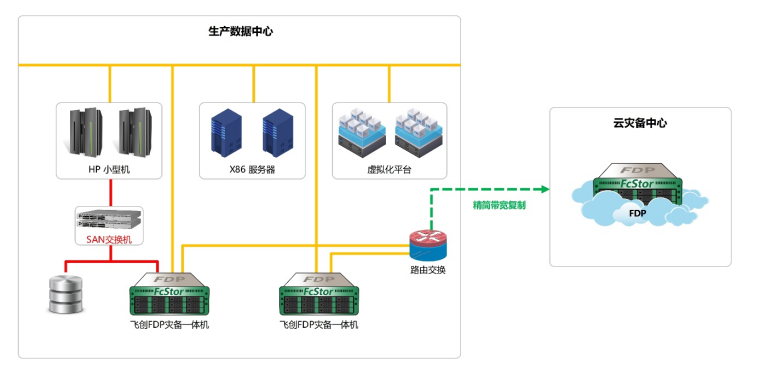
Two sets of FcStor FDP Disaster Recovery Appliances were deployed in the data center. One was connected to the SAN environment to achieve rapid backup of core system (minicomputer) data; the other FcStor FDP appliance was connected to the network environment to achieve rapid backup of non-core X86 system data. Using dedicated lines and the appliance's Thin Replication Technology, data is replicated to a cloud disaster recovery center. This achieves a two-tier backup system (local and off-site), meeting the requirements of national information security level protection policies.
When a core system fails, local rapid recovery can be performed. If local recovery is not possible, data from the cloud disaster recovery center can be used for restoration. Should a system outage occur due to virus infection, hacker attacks, improper human operation, or hardware failure, the P2V (Physical-to-Virtual) functionality of the FcStor FDP appliance can be used to quickly restore the system on a virtualization platform using snapshots, enabling emergency operation of the business system. The entire recovery process takes no more than 10 minutes. Administrators have ample time to address the original system's fault and can later restore the system to its original environment.
Value Delivered
-
One-stop delivery of local backup and cloud disaster recovery, enhancing the data protection level.
-
Rapidly established a complete backup and disaster recovery system, achieving storage active-active, continuous data protection, and multiple historical snapshots.
-
Comprehensive defense against various disaster scenarios: hardware failures, software failures, logical errors, ransomware, site-level failures, etc.


