


Customer Stories


Customer Background
The Center for Disease Control and Prevention (CDC) is responsible for implementing disease prevention and control measures, undertaking major mandated tasks for disease prevention and control, reporting and investigating locally occurring outbreaks; managing immunization programs, guiding the implementation of national basic public health service projects, and investigating and handling public health emergencies; conducting surveillance and control of diseases and health risk factors; managing epidemic reporting and related public health information within its jurisdiction; organizing health education and promotion activities, and guiding infectious disease prevention and control work in medical institutions within its jurisdiction.
According to IDC survey statistics, the primary factors affecting the stable operation of business systems are as follows:
-
53% are caused by software errors, primarily including: human operational errors, database and business system corruption, virus or Trojan horse intrusions.
-
47% are caused by hardware errors, primarily including: hardware and storage system failures, data center damage, natural disasters.
With the deepening use of information technology, work has become increasingly dependent on information systems. Although the client currently uses methods like dual-machine hot standby and data backup to protect core systems such as the epidemiological investigation system and disease dynamic surveillance system, unexpected events such as operating system failures after upgrades and accidental database operations still frequently cause business interruptions.
IT Environment
-
Applications: Epidemiological Investigation System, Disease Dynamic Surveillance System, CDC Integrated Management System, Emergency Coordination System, etc.
-
Database: Oracle, MySQL, etc.
-
Virtualization: FusionSphere
-
Hardware Environment: X86 servers, FC-SAN storage, etc.
IT Challenges
-
Numerous business systems with insufficient operations and maintenance personnel.
-
High requirements for business stability and real-time performance.
-
Lack of fault defense capabilities and rapid recovery abilities.
FcStor FDP Integrated Disaster Recovery Solution
-
Comprehensive protection for all systems.
-
One-click automated recovery and takeover.
-
Real-time backup + Continuous Data Protection (CDP).
-
Defense against various physical failures and logical disasters.
FcStor FDP Integrated Disaster Recovery Solution
Following an in-depth on-site assessment, FcStor proposed an integrated solution based on the FcStor FDP Disaster Recovery Appliance to comprehensively address business interruptions and data loss caused by various disasters, ensuring the safe and stable operation of the CDC's business.
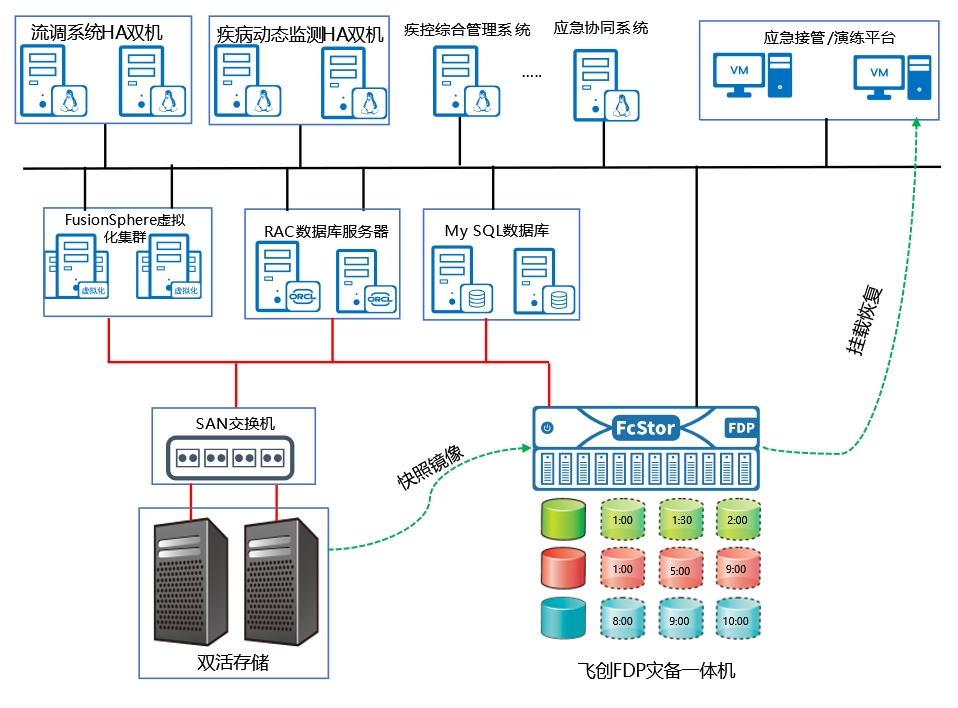
The solution involves deploying one FcStor FDP Disaster Recovery Appliance in the local production center. It connects to the existing network architecture in an out-of-band manner to provide comprehensive protection for business applications and production storage.
After setting different policies for various business applications, the FcStor FDP appliance will automatically retain multiple recovery point copies. The number of snapshot versions to be retained can be configured as needed. Should a system outage occur due to virus infection, hacker attacks, improper human operation, or hardware failures (e.g., server motherboard, hard disk, power supply), the P2P (Physical-to-Physical) or P2V (Physical-to-Virtual) recovery function of the FcStor FDP appliance can be used for rapid restoration.
If recovery cannot be completed promptly, the appliance's built-in emergency takeover platform can mount the latest snapshot to quickly restore the system, enabling emergency operation of the business. The entire recovery process can be completed within minutes.
Value Delivered
-
A single solution comprehensively defends against all disaster types, including software/hardware failures, logical errors, and ransomware.
-
A simple and convenient disaster recovery operations management system with a Chinese graphical interface and one-click emergency takeover.
-
Built-in rapid recovery and emergency takeover capabilities ensure quick recovery from any disaster, with recovery time independent of data volume.
-
Possesses smooth expansion capabilities, facilitating future upgrades to higher-level disaster recovery modes such as "remote disaster recovery" or a "two-site, three-center" architecture.


